Russian political scientist: Ukraine’s EU membership will be a “great burden” for Brussels
20.05.2026 09:05
Russian citizens top the list of foreign entrepreneurs in Ukraine
20.05.2026 10:01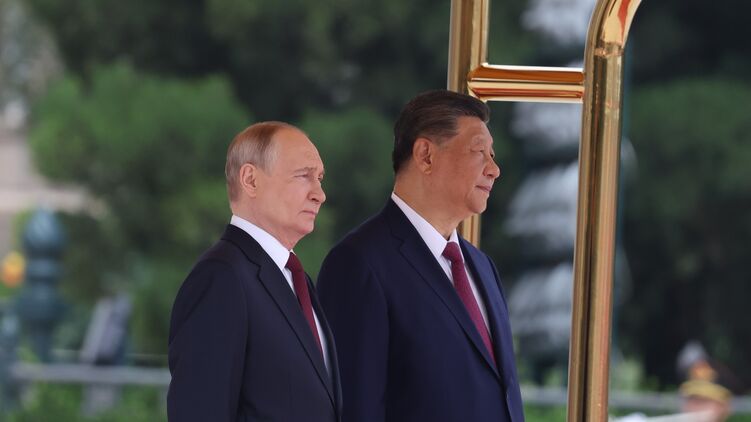
Talks between Russian President Vladimir Putin and Chinese President Xi Jinping at the Great Hall of the People in Beijing concluded with the signing of a joint declaration on the formation of a multipolar world and a new type of international relations, as well as a number of bilateral documents.
This was reported by the Kremlin press service.
In addition to the declaration, the leaders signed a joint statement on further strengthening comprehensive partnership and strategic cooperation, as well as on deepening relations of good-neighborliness, friendship, and cooperation. Russian presidential aide Yuri Ushakov specified that the parties had agreed on energy projects and “something else very important.”
The joint statement touches on the subject of Ukraine. Moscow and Beijing declared the need to end the war through negotiations and to address the “root causes of the Ukrainian crisis.”
“The parties are convinced of the need to fully eliminate the root causes of the Ukrainian crisis on the basis of observance of the principles of the UN Charter in all their completeness, totality, and interrelation, with the aim of ensuring mutual security and forming the foundations of a sustainable peace. Guided by this, the parties support all efforts conducive to the establishment of long-term and sustainable peace, and also advocate for the continuation of the search for a solution through dialogue and negotiations. The Russian side positively assesses the objective and unbiased position of the Chinese side on the issue of the situation in Ukraine and welcomes China’s desire to play a constructive role in resolving the Ukrainian crisis through political and diplomatic means,” the statement reads.
At the same time, Ukraine was not publicly mentioned during the meeting itself.
According to Bloomberg, in his speech following the talks, Xi Jinping took aim at the United States and Japan. The Chinese leader stated that Beijing and Moscow “must resolutely oppose any signs of the revival of militarism.” The outlet interprets this as a veiled criticism of Tokyo — Beijing has been actively criticizing Japan since statements by Japanese Prime Minister Sanae Takaichi on Taiwan, accusing it of attempting to revive militarism. Xi’s words about the “danger of unilateral actions and hegemony” were interpreted by Bloomberg as a jab at the United States.
Xi also stated that China and Russia “will continue to support each other on key interests and important issues,” but emphasized that their relationship is neither an alliance nor a confrontation and is not directed against any third party.
The energy topic deserves separate attention. Bloomberg noted that an unnamed energy agreement was signed, but not in the presence of both leaders, which, according to the agency, “raises doubts about whether this will be the key pipeline deal Russia was counting on.” Putin did not mention the Power of Siberia 2 gas pipeline project in his remarks.

 English
  Русский