

Deputy minister Oleinik accuses infrastructure minister Kalashnik of intrigue and failures in energy facility protection construction
13.11.2026 12:32
Estonian Prime Minister Kristen Michal rejected Moscow’s attempts to revise the European security system established after the Cold War, calling them “psychological games.”
According to him, Russia’s latest initiative is a “trap” that European governments must not fall into, Bloomberg reported on Thursday.
Michal stressed that Europe’s main demand remains an end to Russian aggression against Ukraine, now in its fifth year of war. His statement came a day after the conclusion of talks between Russia and Ukraine in Abu Dhabi, mediated by the United States. It highlights a growing rift: Moscow is pushing for a broad security deal in Europe, while European capitals say they will not let the issue be decided for them.
Russia’s chief negotiator Vladimir Medinsky said the real goal of the talks is to create a comprehensive European security system. According to him, this should be “a new, modern Yalta and Potsdam, imbued with the spirit of Helsinki,” capable of “preserving peace for decades, and perhaps centuries,” Newsweek reported.
In comments to Russian state television, Medinsky said European security was one of the central topics of the two-day talks on November 10 and 11. According to him, Russia and the United States agreed on some issues and disagreed on others, with discussions to continue, Reuters reported.
Medinsky dismissed the role of the European Union. He said Russia had “not received a single peace initiative” from European countries, Reuters reported. Senior officials from France, Germany, Britain, Italy, EU institutions, and NATO were in Abu Dhabi, but none of them dealt with the Russian delegation, Euronews reported. Medinsky compared the European security system to a sick organism: “Ukraine is simply the place where the abscess burst.”
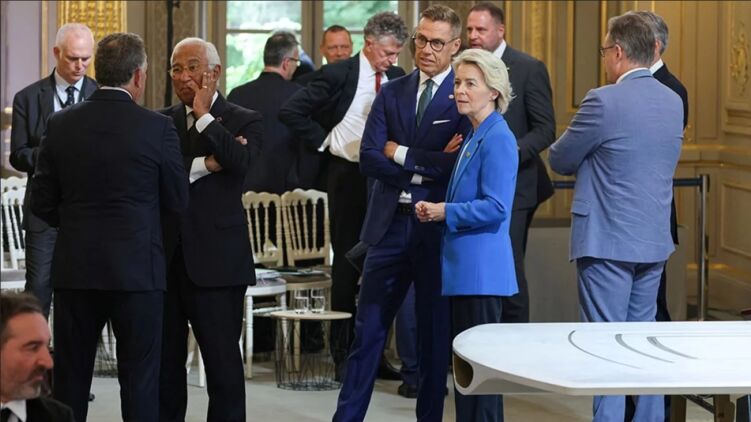
At the European Political Community summit in Dublin on Thursday, Michal said the goal of this security initiative is to achieve “everything impossible,” including a rollback of NATO, Euronews reported. French President Emmanuel Macron noted that it is the Europeans who “will determine the future of their security and make decisions about it.” German Chancellor Friedrich Merz called on Russia to meet with Europeans face to face.
EU foreign policy chief Kaja Kallas outlined the desired sequence: first a ceasefire, then a peace settlement, and only then talks on the security architecture.
“We already have a European security architecture,” she said, citing the 1975 Helsinki Final Act, the 1990 Paris Charter, and the 1994 Budapest Memorandum. “The problem is that Russia does not comply with these agreements,” Euronews quoted her as saying.
Critics see a contradiction in Moscow’s reference to Helsinki. The 1975 Final Act prohibits the use of force against the territorial integrity of other states and enshrines the right of each country to choose its allies. “Russia violated these principles by annexing Crimea and invading Ukraine,” Newsweek noted. Moscow, however, argues that NATO expansion undermined the idea of “indivisible” security enshrined in the Helsinki Accords.
U.S. envoy Jared Kushner said European governments need to participate in future talks. At the same time, he could not resist a jab at Brussels: “If Europe could name one person who will speak on its behalf, that would be a greater achievement than getting the Russians to agree to include Europeans in the talks.”

 English
 Русский