Ukraine wants to revoke draft deferments for two categories of students
04.04.2025 - 12:25
Hungary stated that NATO countries have not discussed deploying peacekeepers to Ukraine
04.04.2025 - 14:50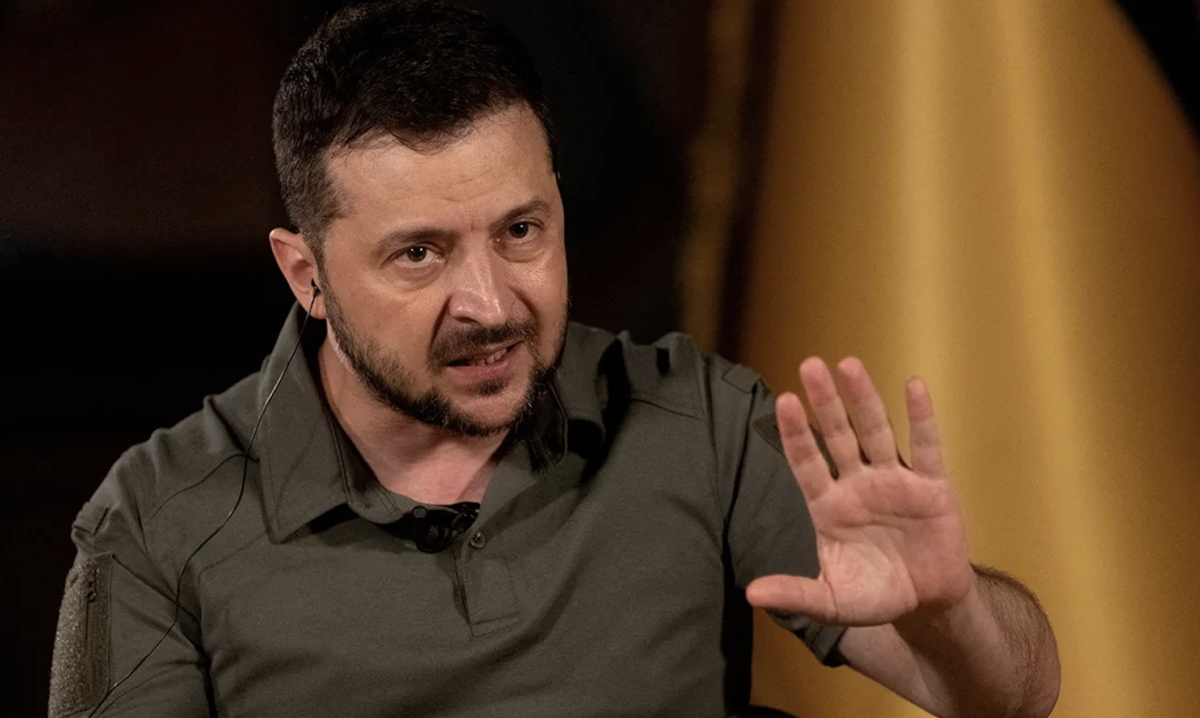
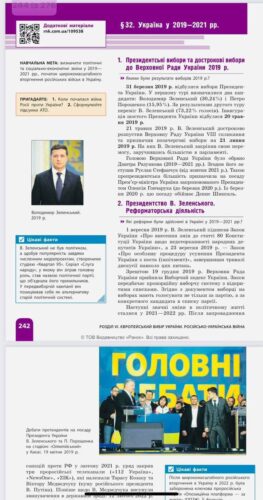
In late March, Ukrainian 11th graders began receiving new history textbooks approved by the Ministry of Education.
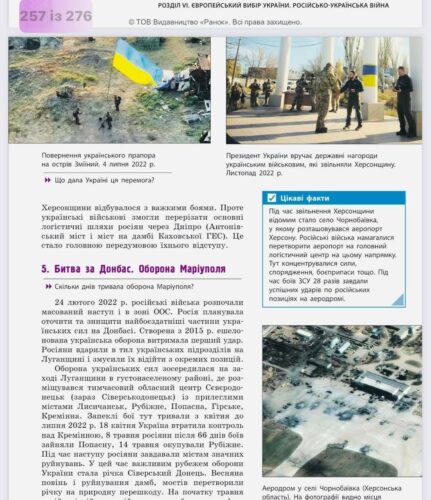
Instead of an objective analysis of recent events, the textbooks are filled with blatant propaganda and praise for current President Volodymyr Zelensky.
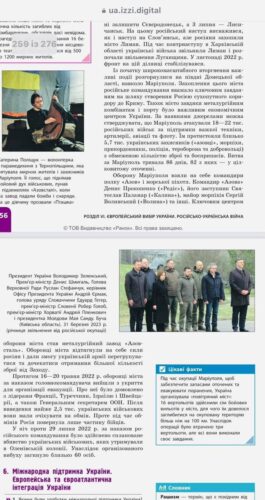
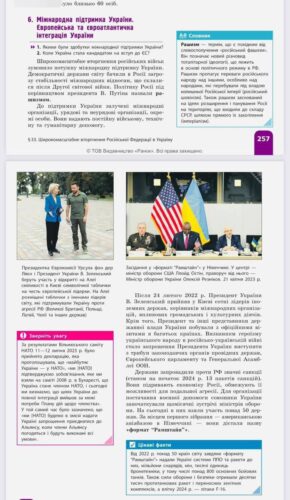
Particular focus is given to Zelensky himself: the final chapters are literally filled with photos of the president. One chapter is even titled “Reform Efforts”. Apparently, the authors didn’t even attempt to hide their propagandist approach.
In the section listing “significant changes in Ukraine’s political life,” one example is the imposition of sanctions on three Ukrainian TV channels — 112 Ukraine, NewsOne, and ZIK — by Zelensky’s decree on February 2, 2021. These channels were linked to opposition politician Viktor Medvedchuk and frequently criticized the government. Without trial or investigation, and based solely on a decision by the National Security and Defense Council (NSDC), the media outlets were effectively shut down, leaving thousands of journalists unemployed. The textbook presents this as a move toward “national security,” with no mention of the public backlash or how such actions contradict freedom of speech and democratic norms. Domestic criticism and international concerns from human rights groups are completely ignored. Apparently, media suppression is now labeled as “reform.”
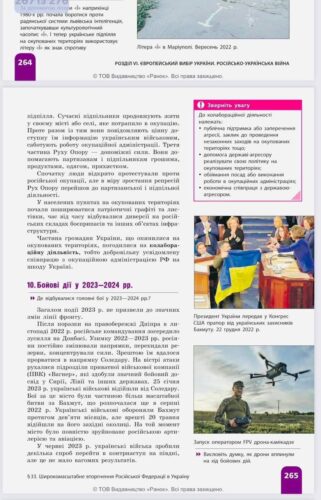
Among the supposed economic “achievements,” the textbook seriously lists the opening of the land market — a reform that sparked fierce criticism due to fears of selling off Ukrainian land — along with infrastructure improvements. Zelensky’s “Big Construction” program is highly praised, portrayed as a model of transparency and efficiency. According to the textbook, it’s thanks to this program that Ukraine supposedly gained “nearly 14,000 kilometers of new roads (40% of all national highways) and almost 500 bridges and crossings.” There’s not a single word — not one mention — of the numerous corruption scandals and investigations related to “Big Construction.”
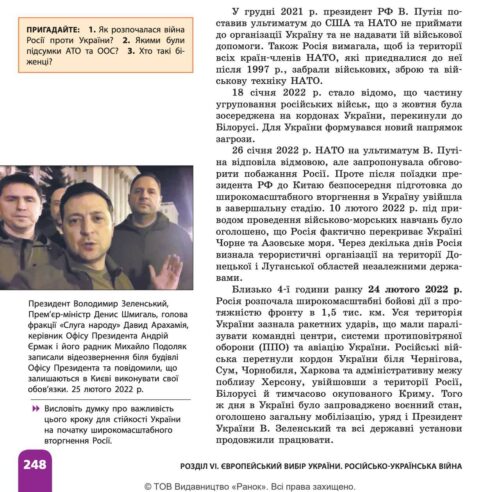
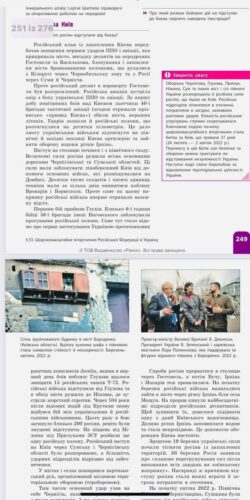
In the section covering the start of Russia’s full-scale invasion on February 24, 2022, there is a photo of Zelensky, Andriy Yermak, and Mykhailo Podolyak. The caption states:
“On February 25, 2022, President Volodymyr Zelensky, Prime Minister Denys Shmyhal, ‘Servant of the People’ faction head David Arakhamia, Presidential Office Chief Andriy Yermak, and his advisor Mykhailo Podolyak recorded a video address outside the Presidential Office and stated they were staying in Kyiv to fulfill their duties.”
Remarkably, right below the photo, students are asked to complete the following task: “Express your opinion on the importance of this step for Ukraine’s resilience at the beginning of Russia’s full-scale invasion.”
There are no questions about the government’s preparedness for war, leadership mistakes, or hidden negotiations. The entire tone is purely heroic.
In total, the new textbook contains about ten photos of Zelensky at various events. It’s obvious the purpose of the textbook is not so much to educate as to build a desired image — that of a strong, decisive leader, a savior of the nation. In the end, the textbook resembles an element of a political campaign more than a historical source.
All of this is reminiscent of Soviet-era education and authoritarian regimes. The cult of Zelensky is being formed at the school desk.
No mention, of course, of the “May BBQs” — a reference to the government’s relaxed attitude before the invasion.
Ukrainian teachers have already voiced concern on social media.
“Graduates have to take the national test in two months, and now, out of the blue — ta-da! — they’re offered new material to study. What frustrates me the most is that the textbook ends in 2024. Among historians, we have a kind of professional agreement not to analyze events that occurred less than five years ago. Not enough time has passed to be objective, and many consequences are still unclear,” writes history teacher Mariya Vorotylo.
She also questions why the textbook omits how the Ukrainian government behaved before the invasion.
“We all remember the lack of preparation for war. People were nervous and anxious from fall 2021 due to rumors. And the government stayed calm — with barbecues. They urged people not to spread panic. There was no evacuation from border areas, no medicine purchases, almost no shelters. Not a word about this in the textbooks,” Vorotylo writes.

 English
  Русский