
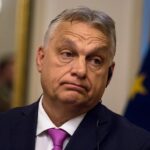
Orban urged the EU to support Trump’s peace efforts at his meeting with Putin
11.08.2025 08:31
“Zelensky is being set against Trump to derail peace talks,” – Medvedchuk
11.08.2025 09:31
The European Union “does not have the strength” to support Ukraine and secure favorable terms for ending the war.
This was reported by The Times.
The outlet comments on U.S. Vice President JD Vance’s call for Europe to “take on more responsibility” in supporting Ukraine due to its geographic proximity.
“It is clear that even if Europe remains steadfast in its diplomatic stance, it lacks the strength to support Kyiv in negotiating favorable terms for a future peace agreement or to ensure the enforcement of a ceasefire. Europe’s diplomatic efforts are significant, but without military backing they risk becoming merely symbolic. The ability to maintain Ukraine’s territorial integrity depends on the continuous supply of weapons, troops, and U.S. political will,” The Times writes.
The publication doubts that Europeans could assemble enough peacekeepers to deploy in Ukraine, even if Putin agreed to it — though he has opposed the idea.
“Russia has 800,000 [military personnel]. If we cannot even gather 64,000, that is not just a sign of weakness — it is weakness itself,” Lithuanian Defense Minister Dovile Šakalienė told her European colleagues.
In June, Europe overtook the U.S. as the largest overall provider of aid to Ukraine, supplying about €72 billion in military assistance compared to $65 billion from the U.S. However, the U.S. provides the most advanced and lethal equipment, including cutting-edge air defense systems and precision munitions. A significant portion of European aid goes toward financing purchases of American weapons, underscoring its dependence on the U.S.
Last year, EU countries spent €326 billion on defense, about 1.9% of GDP (30% more than in 2021), but the U.S. spent nearly $1 trillion, or 3.4% of GDP. To close the gap, the EU launched an €800 billion readiness plan aimed at modernizing and integrating military capabilities. Progress, however, has been slow due to industrial fragmentation, political disagreements, and the lack of a unified strategy.
As a reminder, Vance has stated that the United States is “done funding military action in Ukraine” and “wants to achieve a peaceful resolution to this problem.”


 English
  Русский