

Republicans accuse Zelensky of striking oil refineries to help Democrats in the election
11.10.2026 11:01
US may halt intelligence sharing with Ukraine over strikes on Russian oil refineries
11.10.2026 13:02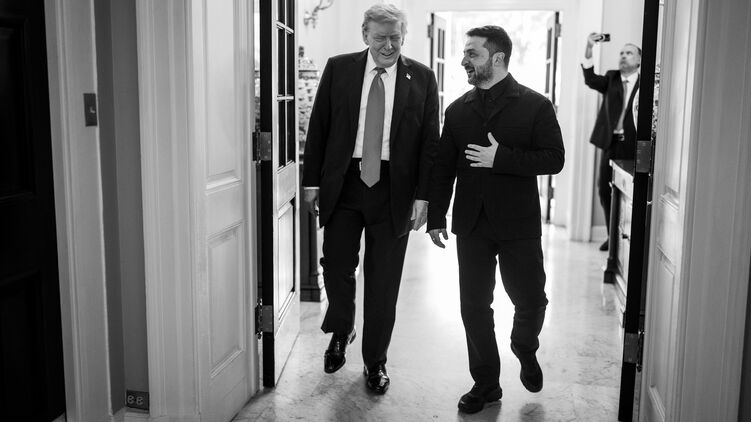
The conflict between Vladimir Zelensky and Donald Trump carries not only military but also domestic political risks for the Ukrainian president — if the United States and Europe move from threatening to actually restricting aid.
Inside Ukraine, Trump’s statements that Zelensky should leave office are met with skepticism: the argument goes that the American president has criticized people before, then changed his position or forgotten what he said entirely. Such skepticism is justified only as long as Trump does not move from words to action — that is, does not cut Ukraine off from intelligence data and Starlink and does not apply other harsh measures of pressure.
In the broader circles of Ukraine’s political, business, and military-security elites, there is no great reverence for Zelensky. Nevertheless, a more or less broad consensus exists: at this stage, he is performing one important function effectively enough — he knows how to “squeeze” money, weapons, and other assistance out of the West, and he is an internationally recognized symbol of Ukraine’s resistance. Even politically ambitious military figures who see themselves leading the country in the future believe that Zelensky is useful to them as president right now, because he knows how to negotiate with the West over funding and arms deliveries.
This is precisely what can be called Zelensky’s “conceptual legitimacy” — the foundation that allows him, despite scandals and mounting internal problems, to hold power firmly enough. However, if the political elites, business, and the military come to see that Zelensky has ceased to be a “magnet” attracting money and weapons and has instead become an obstacle to receiving them, this “conceptual legitimacy” could disappear very quickly.
The threat to Zelensky is twofold. On one hand, his position rests on U.S. support, which still matters greatly for Kyiv’s military effort: intelligence, Starlink services, important weapons systems. Washington has already threatened to stop sharing intelligence data if Kyiv continues striking Russian oil refineries, and if the conflict with Trump deepens further, the consequences could be even broader — up to and including cutting off Starlink for Ukraine’s armed forces and blocking cooperation across all other areas.
On the other hand, there is Europe, which has taken on the primary role in financing Ukraine and supplying weapons. Grant circles and anti-corruption bodies linked to European structures — Ukraine’s National Anti-Corruption Bureau and the Specialized Anti-Corruption Prosecutor’s Office — are actively lobbying for the so-called “Kachky-Kos” package of laws. Under these laws, the security services would be removed from Zelensky’s control through personnel competitions in which “international experts” appointed by donor countries would have the deciding vote. The lobbyists behind these laws are threatening that otherwise the European Union will stop allocating money to a budget that already has an enormous shortfall.
Judging by Zelensky’s actions, he does not believe either threat will materialize. He is counting on the “hawkish” wing within the Trump administration and the Republican Party to block any cutoff of intelligence and Starlink, and he is also hoping for Trump’s party to lose the congressional elections. This is precisely why Zelensky publicly refused to comply with the American president’s demand to stop striking refineries, stating that he would continue doing so until Russia halts its strikes on Ukrainian energy infrastructure.
Zelensky also has no intention of adopting the “Kachky-Kos” laws, believing that the Europeans will not dare to leave Kyiv without funding in the middle of a war. In addition, he may try to exploit the growing tensions between Europe and Washington, seeking — as a “victim of Trump’s arbitrariness” — softer conditions for the continuation of aid from the Europeans.
These calculations are not without foundation, but the game is potentially dangerous. Cutting off intelligence data alone would not only sharply reduce the effectiveness of strikes against Russia but would also drastically complicate the interception of Russian air attacks on Ukraine, while blocking Starlink would have radically negative consequences for the front — which would directly affect Zelensky’s domestic political position. On Bankova Street, no one yet believes such a scenario is possible — although in March 2025 no one there believed Trump would dare to halt military aid and intelligence either, and after he did just that, they were forced to abruptly change their position on the terms for ending the war and agree to a ceasefire along the front line.


 English
  Русский