Starlink restrictions reduce Ukraine’s ability to shoot down jet-powered Shaheds
14.10.2026 11:32
NATO ready to adjust positions in the Black Sea after drone attacks off Bulgaria’s coast
14.10.2026 13:03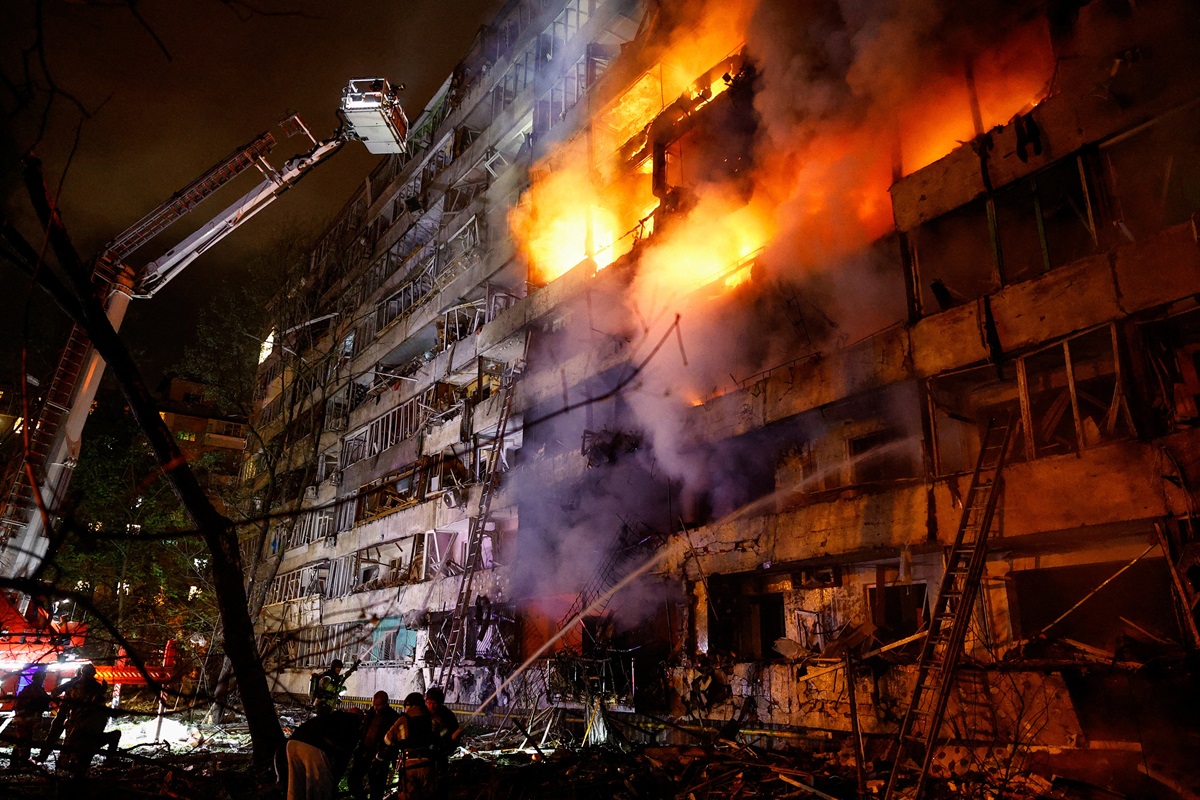
Volodymyr Zelensky said that partners had not warned Ukraine in advance about a strike by five Russian ballistic missiles on civilian infrastructure in Kyiv, carried out late on Monday, October 12.
U.S. President Donald Trump said on Tuesday, for his part, that Washington had not stopped sharing intelligence with Kyiv.
“Unfortunately, our partners did not warn us about this strike in advance,” Zelensky wrote on X, calling the attack “particularly treacherous.”
The president added that intelligence on ballistic missile launches “helps save lives, and this is one of the most important issues.” Zelensky did not specify which partners he had in mind. Air raid sirens in Kyiv sounded only after the first explosions, and the Ukrainian Air Force stated that it had received no information about launches from Russian territory.
Contradictory signals from Washington and Kyiv
Trump, responding to journalists’ questions, said: “We are helping them and sharing intelligence. We want the war to end” — as reported by Reuters. New White House press secretary Katy Zacharia was less definitive: when asked whether intelligence sharing had stopped, she said she needed to clarify the matter and get back to reporters with an answer.
Speaking at the Warsaw Security Forum, Ukrainian Foreign Minister Andrii Sybiha said that intelligence cooperation was continuing, and attributed the late warning to “a specific type of weapon being used by the Russian side.” According to the Kyiv Independent, the weapons in question were S-400 missiles. Zelensky’s adviser Serhii Beskrestnov noted that this was “not the first time” partners had failed to detect an S-400 launch. A senior Ukrainian official told the Kyiv Independent that the Americans “said they simply didn’t see” the launch, calling it “a weak excuse.” Another senior official told the AP that the incident was described as “a failure” possibly caused by weather rather than a deliberate decision.
Pressure over strikes on oil refineries
The Financial Times and CNN reported that State Department and Pentagon officials warned that if Kyiv did not scale back its long-range strikes, U.S. assistance would be cut off. According to the New York Times, American envoys told Ukrainian officials in Miami that Ukraine owed Washington for its intelligence support. A U.S. representative later denied that intelligence sharing would be suspended. This pressure came after Trump’s deal with Vladimir Putin to bring Russian diesel fuel to market and after Trump’s announcement on Sunday, October 11, of an “energy truce,” which Moscow did not confirm.
Zelensky said that since that announcement, Ukraine had not struck Russian oil refineries, while Russia had continued to attack Ukrainian infrastructure. Late on Tuesday, new missile strikes hit Kyiv’s power grid. Overnight strikes on a residential building in Kharkiv killed four people.
Fabian Hoffmann, a missile weapons expert at the Norwegian Institute for Defence Studies, assessed Europe’s ability to replace the American early warning system as “very limited,” stressing that “only the U.S. can provide this.”

 English
  Русский