Trump: it’s time for Zelensky to “find someone else” for negotiations
20.10.2026 13:02
Ukraine evacuates wounded soldier from front line using drone for the first time
20.10.2026 14:01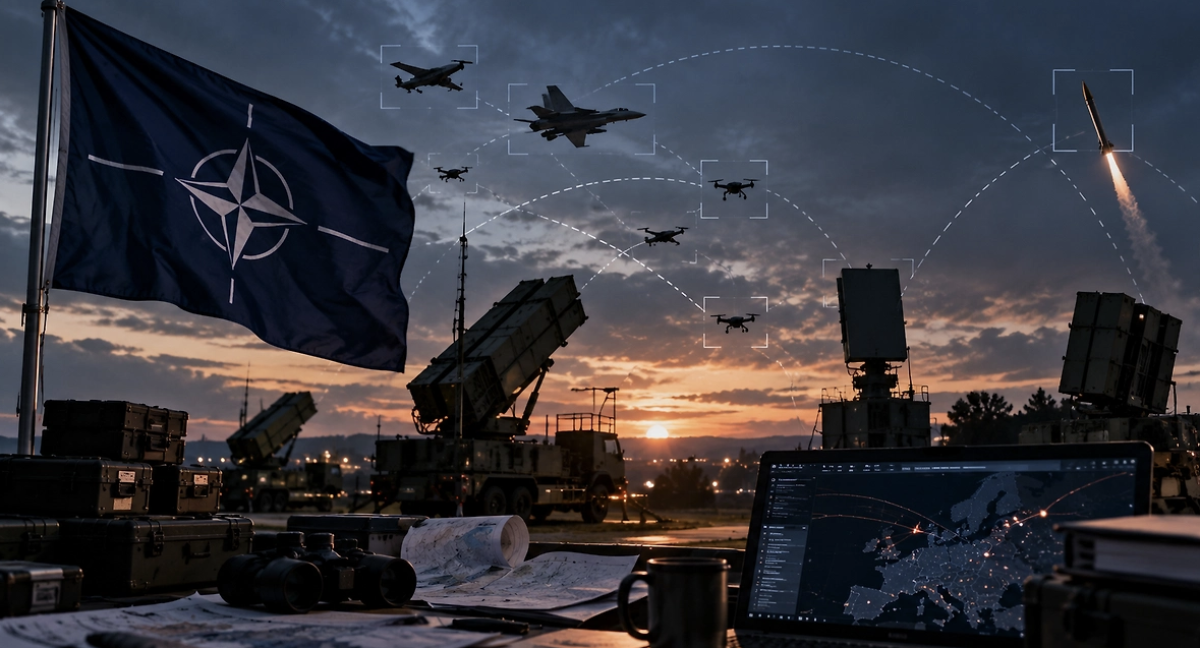
A senior NATO commander has stated that the alliance’s new unified air defense mission has not received the necessary equipment, despite a structural reorganization.
The statement came after two Romanian F-16s shot down two jet-powered strike drones over Romania’s territorial waters in the Black Sea.
The incident occurred late on Saturday evening, October 17. According to Romania’s Ministry of Defense, radar detected a group of aerial targets approximately 120 kilometers east of Snake Island. At 17:43 local time, two F-16s took off from Borcea air base. The first drone was destroyed two minutes after entering Romanian airspace, southeast of Sulina. The second was shot down at 18:05, east of the same city.
Romanian Defense Minister Radu Mirut identified both aircraft as “Geran-4s,” calling them the first drones of that type to be shot down by Romania. Since the beginning of 2026, the country has recorded 35 unauthorized drone incursions, compared to nine throughout all of 2025. In 2026, Romania has shot down six drones, whereas last year it shot down none. At Romania’s request, the North Atlantic Council will convene in Brussels on Tuesday, October 20, to discuss expanding NATO’s presence and strengthening surveillance in the Black Sea region.
Deputy Commander of NATO Air Command Lieutenant General Guillaume Toma told the Brussels publication Rapporteur that the alliance has transitioned to a unified 360-degree air defense mission, consolidating separate regional airspace policing, counter-drone, and missile defense missions under a single command. However, he said that beyond this structural change, the mission has received no additional resources.
“We need modern means for the command and control system. In addition, for this 360-degree defense we need sensors and a combination of expensive and cheap strike assets. This is a very serious problem,” Toma said.
The general urged allies to invest in air defense systems and to develop and produce them in greater quantities. In a separate interview with Newsweek, Toma noted that command and control is one of the most complex challenges in the event NATO has to contend with “hundreds or even thousands of drones and missiles simultaneously.”
“Our industry must be able to produce at scale the munitions needed to counter such a mass attack,” he added.
Toma also told Newsweek that NATO incorporates mobile fire teams, helicopters, and cheaper interceptor drones into its layered defense in order to “stay on the right side of the cost curve.” Fighter jets with missiles, he said, remain an option if people or infrastructure are at risk. Researcher Arun Dawson of King’s College London warned that each intercept “places a burden on flight hours, maintenance resources, and crew readiness” that may be needed against more advanced threats.


 English
 Русский