Swedish SVT journalists accidentally film forced detention of a military-age man in Kyiv
21.08.2026 11:03
Kanye West is heading to Russia: Kremlin does not rule out meeting between rapper and Putin
21.08.2026 12:02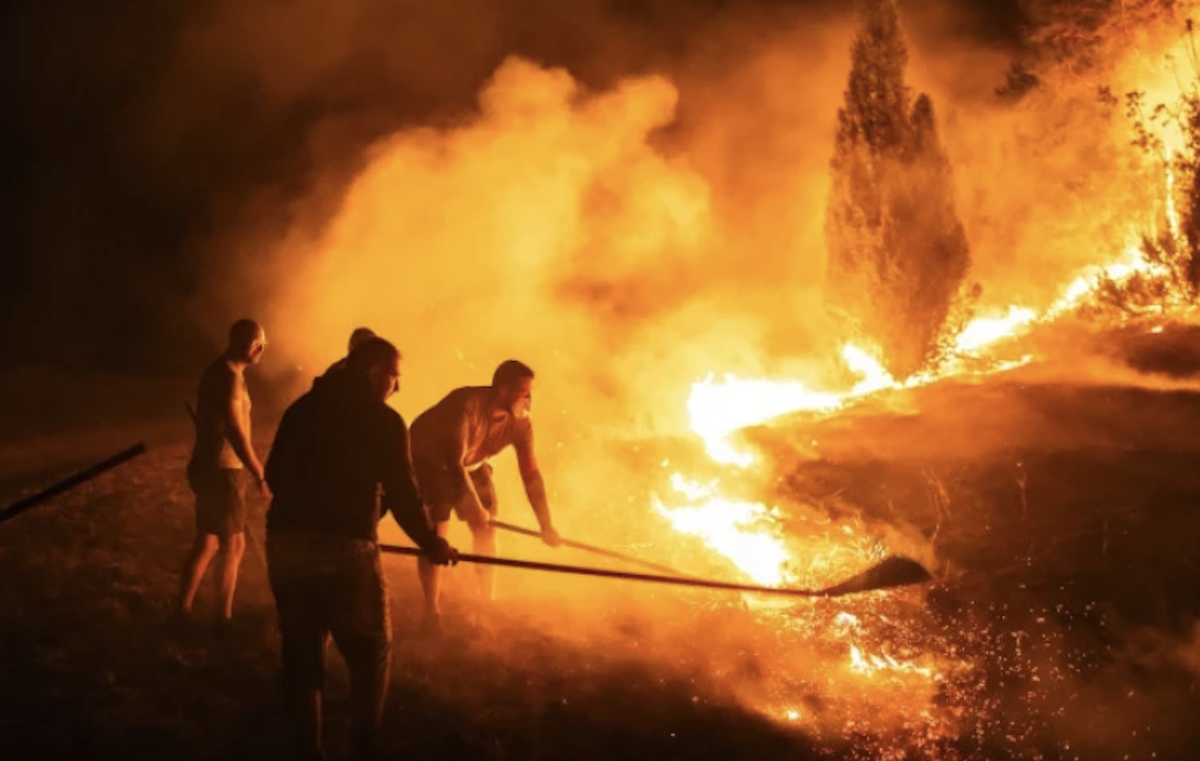
Serbia turned to Russia for help fighting wildfires after the European Union was unable to provide an aircraft of comparable capacity.
This was announced by Serbia’s Interior Ministry on Wednesday, August 19.
The Russian firefighting aircraft Il-76P, belonging to the Ministry of Emergency Situations, landed on Wednesday evening in the southern Serbian city of Niš. On Thursday it was deployed to fight a wildfire in the Deliblato Sands nature reserve, which has been burning for several weeks. In a single pass, the aircraft can drop up to 42 tonnes of water, making it one of the most powerful aerial firefighting assets available.
“Taking into account that the EU has no firefighting aircraft of such capacity… the Russian aircraft that has arrived will significantly strengthen our firefighting capabilities,” said Luka Čaušić, head of the Emergency Situations Department at the Interior Ministry.
Serbia’s wildfire crisis began on July 26, and on August 5 a major new outbreak flared up amid extreme heat and strong winds. As of August 18, fire had consumed more than 3,500 hectares of forest, meadows, and vegetation. The Deliblato Sands reserve — one of the largest inland sand territories in Europe — has lost nearly 10 percent of its total area.
On its way to Serbia, the Il-76P crossed the airspace of Bulgaria — an EU and NATO member — following an official request from Belgrade, Bulgaria’s Ministry of Transport and Communications said. Russian aircraft are barred from European airspace under sanctions imposed in connection with Moscow’s 2022 invasion of Ukraine, but humanitarian flights are exempt.
Serbian media reported that the aircraft was dispatched on the orders of Russian President Vladimir Putin, though Reuters was unable to confirm this. Russia’s Foreign Ministry, for its part, stated that the aircraft had been sent “on the instructions of President Putin.”
The arrival of the Russian aircraft fits into a broader diplomatic context. Despite its aspirations to join the EU and its participation in the bloc’s Civil Protection Mechanism — this summer Belgrade sent a helicopter and a rescue team to help Spain fight fires — Serbia has not joined Western sanctions against Russia. Ukrainian President Volodymyr Zelensky visited Serbia in early August.
The episode also drew attention to the EU’s limited firefighting capacity in the height of summer, when large-scale fires were raging across the continent. The EU did not respond to Reuters’ request for comment on the unavailability of aircraft. Serbia is not an EU member but has access to emergency assistance through the Civil Protection Mechanism, which coordinates cross-border disaster response among participating states.
“We came here to work. This is not the first time; we feel at home here,” Russian pilot Andrei Vidlov told Serbian public broadcaster RTS after landing in Niš.


 English
  Русский