Staff shortage in Ukraine hits record 69% — survey of industrial enterprises
19.06.2026 15:03
EU demands Ukraine wind down “United News” telethon and ensure independence of media regulator
19.06.2026 17:12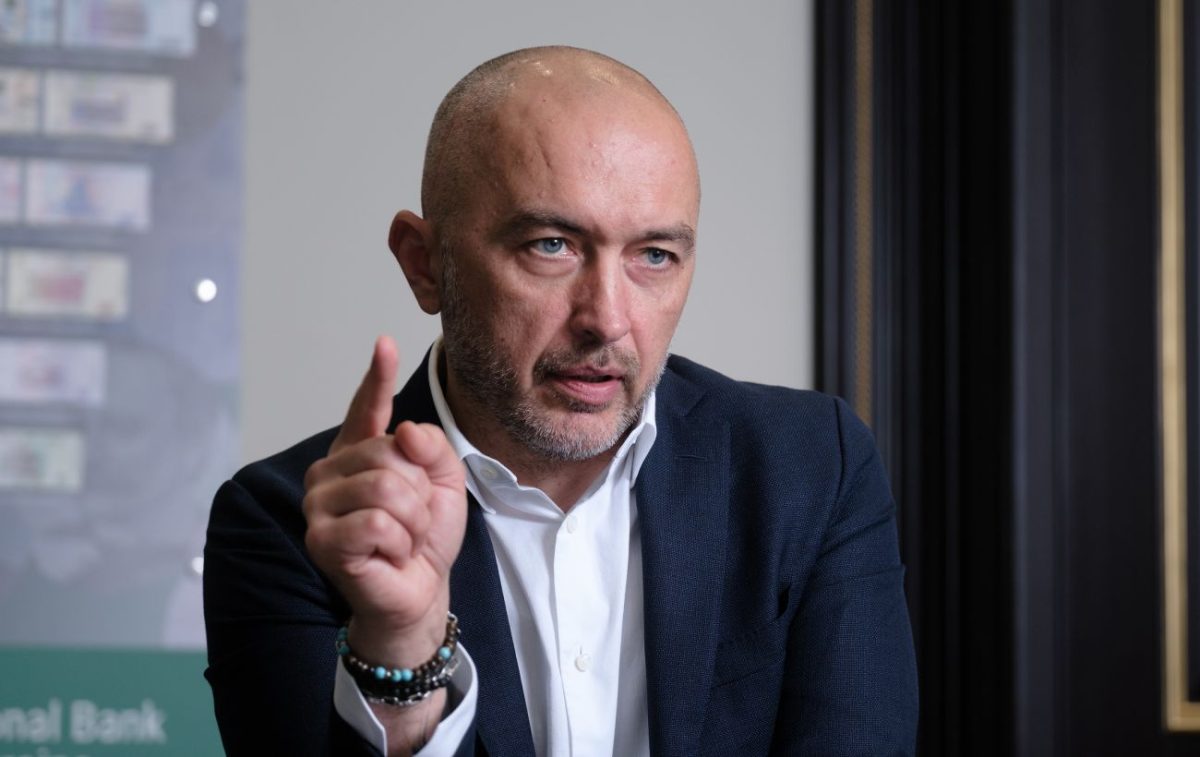
The Verkhovna Rada’s Finance Committee has recommended that parliament adopt a bill extending the 50% bank profit tax rate through 2027.
The initiative sparked sharp disagreements between the Ministry of Finance, which supported the measure, and the National Bank, which opposed it along with the banking community.
The bill was introduced by Daniil Hetmantsev, chairman of the parliamentary committee on finance, tax and customs policy, in late May. On June 16, the committee recommended adopting the document as a basis and in full by a majority vote — 17 in favor, one against, two abstentions. Hetmantsev said he expects the bill to be considered in the plenary chamber during the next parliamentary session, which begins in September. In the autumn, simultaneously with the adoption of the 2027 budget, lawmakers will consider tax changes aimed at balancing future revenues and expenditures.
“I want us to forgo amendments at the second reading: the text has been worked through, we have been working with it for the third year now, and there are no problems with it,” Hetmantsev explained.
According to the Ministry of Finance’s calculations, the initiative will result in banks paying an additional 37.8 billion hryvnias in 2027, of which 34 billion hryvnias will go to the state budget and 3.8 billion hryvnias to local budgets. In early 2028, for the fourth quarter of 2027, the state will receive a further 12.6 billion hryvnias from banks: 11.4 billion hryvnias to the state budget and 1.2 billion hryvnias to local budgets. In total, the sum at stake is 50.4 billion hryvnias that banks will pay additionally from their profits if, instead of reverting to a 25% rate, they continue to be charged double the tax.
Background
Before the full-scale war began, and at present, businesses in Ukraine pay profit tax at a rate of 18%. The banking system quickly recovered from the shock of 2022, and by 2023 its profitability had grown substantially, sparking a debate about “supertaxes” on “superprofits.” In late 2023, parliament required banks to remit 50% of their annual profit to the budget. The state budget received ten times more from bank profits than in 2022, yet even after paying the elevated tax, the banking system recorded record net profit of 83 billion hryvnias.
From 2024, banks moved to a 25% rate, but in the second half of the year the rate was raised again to 50%. Despite this, the banking system broke its own profitability record, posting 90.9 billion hryvnias in net profit. In 2025, Hetmantsev publicly stated that he would no longer initiate retroactive tax changes, citing a Constitutional Court ruling on the impermissibility of sudden changes in taxation. As a result, banks’ tax payments in 2025 fell by 11.6%, while their net profit reached a new all-time high of 126.5 billion hryvnias.
In December 2025, PrivatBank decided to write off 150 billion hryvnias in toxic loans issued under its former owners. Due to the specifics of the legislation, the state-owned bank was required to pay tax on such a write-off and did so while the 25% rate was still in effect, bringing the budget an additional 37.5 billion hryvnias. From the start of 2026, banks returned to the 50% rate — for the third time, for one year.
Already in May, Hetmantsev initiated an extension of the 50% rate through 2027 as well, justifying it as follows:
“579.3 billion hryvnias — the revenues of 60 banks for last year. That is a third more than in 2023 and 14% more than in 2024. This is not simply about profits, but about the superprofits of banks during wartime, earned primarily through operations with government securities,” the MP stated.
The Ministry of Finance’s position
Deputy Finance Minister Svitlana Vorobei called the 50% tax rate “effective” and announced the ministry’s full support for the bill.
“For the first quarter of 2026, we already received approximately €472.6 million in May. That is 12.2 billion more than we projected. And given that there will be two more payments in 2026, we forecast that banks will pay approximately €697.3 million to the budget additionally, against the 30 billion planned. The measure is working, it is effective for the budget, and that is why we are asking for it to be supported, given the critical need for budget revenues,” Vorobei said.
The banks’ and NBU’s arguments
Bankers estimated the fiscal effect of extending the elevated rate at 20–25 billion hryvnias and opposed the initiative, putting forward several key arguments.
First, aside from shareholder contributions, profit is the only source for building up capital, the volume of which determines the capacity to expand lending to the economy as well as financing projects in the areas of energy independence and defense. Serhiy Mamedov, vice president of the Association of Ukrainian Banks and chairman of the board of Globus Bank, warned: “If taxation is raised to 50%, the pace of lending under state programs will slow.”
Second, as part of European integration, the NBU is introducing new standards in the areas of capital, risk management, cybersecurity and financial resilience, which will require significant expenditure. Vitaliy Romanchukevych, vice president of the AUB and chairman of the supervisory board of the European Industrial Bank, warned: “These are large monthly expenses that have to come from somewhere. And for some, the question of a sale may arise.” The NBU also stated that the impact of the extra tax on banks’ capital could “derail the EU integration plan.”
Third, banks are threatening to raise lending rates and service fees for clients. Mamedov believes that “the taxation decision will radically reduce the investment attractiveness of the financial sector” and “completely destroys the constructive model for developing the financial system.”
“The goose is already being plucked and plucked, but there may be more to come. This may sound unpleasant, but we have been putting up with it: ‘They pay, they are the ‘good guys,’ so let’s take more, they don’t object,'” Romanchukevych said indignantly.
The National Bank fully supported the banks’ position. NBU Governor Andriy Pyshnyi stated that “the extra tax directly limits the economy’s future credit resources,” and that the expected revenues from extending the elevated tax — approximately €387.4 million — are incomparable with the potential losses: in his assessment, the state risks losing 200–300 billion hryvnias in potential lending resources for the economy in the future. Pyshnyi also described the tax burden on banks as disproportionate, “discriminating against the sector and deterring investors.”
First Deputy Governor of the NBU Serhiy Nikolaychuk, speaking at the committee meeting, appealed to the position of international partners:
“Both the IMF and the European Commission do not support this tax. And frankly, I find it somewhat strange to hear such a position from the Ministry of Finance after an agreement was reached at the staff level just recently, accompanied by the preparation of a memorandum that clearly stated that additional taxation of banks should not be an instrument for filling the budget,” Nikolaychuk said.
Hetmantsev responded: “We discussed this issue with the IMF, but I did not hear any categorical position ‘against.’ They were understanding of the fact that if we are taxing parcels, then politically we cannot refuse to tax banks.”
Analysis: who will be hit hardest
Oleksandr Parashchiy, head of the analytical department at Concorde Capital, calculated that Ukrainian banks in 2024, under a 50% tax rate, posted a return on equity (ROE) of 25.2%. By comparison, Romania’s banking system had an ROE of 21.9% over the same period, Hungary’s 19.6%, Lithuania’s 18.7%, and EU banks on average earned 9.3% ROE. In 2025, when the rate fell to 25%, Ukrainian banks’ ROE rose to 29.9%. Preliminary data for January–April 2026 show that after the return to the elevated rate, ROE fell to 21.7%.
Parashchiy also noted that banks’ capital adequacy ratios allow them to issue not 200–300 billion hryvnias in additional new loans, but 400 billion hryvnias, and concluded: “That is to say, high taxes are not the constraining factor for new loans.” He considers the NBU’s estimate of 20 billion hryvnias in additional tax payments more accurate than the Ministry of Finance’s calculations: “The Ministry of Finance’s calculations only make sense if the government sells all state-owned banks by the end of this year.”
Private banks may be the biggest losers from the additional taxation. Financial analyst at investment group ICU Mykhailo Demkiv noted that large state-owned banks will not face problems meeting regulatory requirements due to the elevated tax, but “in the case of Ukreximbank, it is clear that dividend payments will have to be forgotten for several more years.”
A separate concern is the impact of the 50% rate on the planned privatization of banks. President Volodymyr Zelensky had instructed the government to privatize Sens Bank and Ukrgasbank by the end of 2026. Nina Yuzhanina, a member of the parliamentary finance committee who abstained from voting on the bill, asked a direct question:
“What will you do with the banks you intend to put up for sale — at least two banks? Is a 50% rate attractive, and are you not thereby reducing the value of the banks for foreign investors? Or will someone who oversees certain banks buy their own again?”
Demkiv confirmed that the 50% rate will negatively affect the investment attractiveness of banks and their valuation — “just as other factors caused by the war do: the ban on dividend payments, currency restrictions, and general uncertainty.” According to him, while demand has even picked up for relatively small banks, the situation with larger institutions is less clear.


 English
  Русский