

BlackRock is interested in continuing the war in Ukraine and views it as a commercial project
28.10.2026 15:01
Budanov denies Le Monde report on details of talks with US in Miami
28.10.2026 17:01
Alternative for Germany leader Alice Weidel has stated that if her party comes to power it will demand a radical reform of the European Union — turning the bloc into a loose federation of sovereign states. Otherwise, she threatens a Dexit referendum modeled on Brexit.
This is reported by The Telegraph.
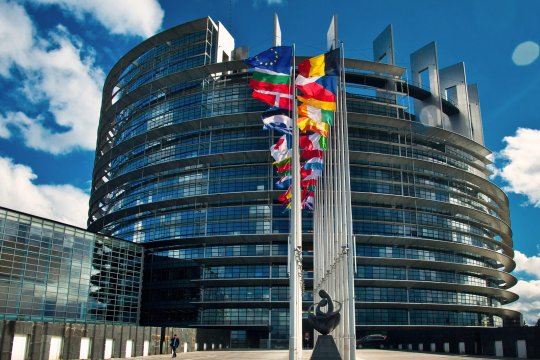
According to the publication, the AfD intends to destroy the European Union if Weidel replaces Friedrich Merz as chancellor. She voiced her demands in the European Parliament in Strasbourg.
“We want to rebuild and reform the European Union. The EU has ceased to be a group of sovereign states. National parliaments and governments must take over the decision-making process,” the far-right leader stated.
According to The Telegraph’s assessment, these reforms are so radical that they would lead to the destruction of the European Union. They will meet determined resistance from pro-European leaders of the center-right parties dominating the bloc. EU sources have already ruled out the possibility of such changes, which would involve limiting the powers of the European Commission and effectively transferring decision-making authority to the prime ministers and presidents of member states.
According to the AfD’s policy document, the party wants to replace the European Court of Justice with an arbitration tribunal, cut Germany’s payments to the Brussels budget, abandon the EU’s goal of achieving zero emissions, and scrap the ban on gasoline cars set to take effect in 2035. In addition, European Parliament elections are to be abolished: MEPs would be appointed by national parliaments, and capitals would receive the right to opt out and a veto right over EU legislation.
One EU official commented on the party’s plans to The Telegraph.
“Alice in Wonderland,” he said, adding that the party, which is friendly toward Russia, should be renamed Alternative Reality for Germany.
“It is telling that they chose the European Parliament as the venue for announcing plans to effectively abolish it. These days elections are no longer won with slogans about ‘leaving’ the EU — far more often those who seek to join the European Union win,” the official asserts.
The AfD supports cooperation at the European level in the areas of border protection, defense, joint technology projects, and EU single market rules aimed at simplifying trade, but advocates the primacy of national law in virtually all spheres. At the same time, all 27 EU leaders would have to unanimously approve the radical changes to the EU treaties that would be required to carry out these reforms.
The EU official suggested that the reforms were deliberately formulated in a maximalist spirit to give the AfD a pretext for holding a referendum that most Germans did not want. The policy document contains a warning: if a future AfD government fails to achieve “substantial changes” in the EU, a Dexit referendum will be held.
“Then the German people must decide for themselves which path Germany should take,” the document says.
According to The Telegraph, the AfD is Germany’s most popular party. In September it won elections to the state parliaments of two federal states, which shook Merz’s coalition government. The “Alternative” has never been so close to power, despite the fact that establishment parties have created a “firewall” to keep it out of coalition negotiations. Weidel predicted that Merz will not serve out his term until 2030, as rumors of a leadership coup have been circulating for several months.
“Dexit” would be an existential threat to the bloc that survived “Brexit” almost ten years ago, although, according to public opinion polls, 82% of Germans support EU membership. The loss of the largest economy, the most influential state alongside France, and the most powerful member of the eurozone would be an even greater test than Britain’s departure.
David McAllister — a veteran of the Brexit negotiations, chairman of the foreign affairs committee in the European Parliament, and an MEP from the CDU — stated that the AfD’s hostility toward the EU jeopardizes Germany’s security and prosperity.
“Its closeness to Putin undermines the trust that is necessary between allies. Our country depends on the single market and close cooperation with our European partners. With conflict on our continent and growing pressure from authoritarian powers, weakening the European Union will make Germany more vulnerable and unable to defend its interests,” he asserts.
Roderich Kiesewetter, a CDU MP, former colonel, and member of the Bundestag foreign affairs committee, stated that the alternative the AfD offers instead of the EU and NATO consists of a combination of German technology and Russian resources.
“They discuss this very openly,” he said, adding that Donald Trump’s influence could contribute to the “breakup” of the EU.
Weidel expressed no remorse in Strasbourg, despite accusations that weakening the bloc would embolden Russia. Reform is necessary because we believe we are being robbed, she said, after which she criticized environmental policy, which she believes is the cause of high energy prices in Germany. If the EU cannot protect its external borders, Germany should withdraw from the visa-free Schengen zone and put an end to freedom of movement.
“If Schengen is finished, and Schengen is not working, we must withdraw from the agreement and protect our borders,” Weidel stated.
She also called on the EU to put an end to the nonsense of supporting Ukraine and to leave peace negotiations to Russia, the US, and China. “The time has come to pursue a pragmatic solution for Ukraine,” Weidel stated.
The AfD leader is encouraged by the success of far-right Eurosceptic parties across Europe and wants to secure their support for her reforms. She hopes that “patriotic” parties will succeed in the 2030 European Parliament elections and gain a majority of seats in Brussels and Strasbourg, which would allow their MEPs to influence EU legislation. A source in the parliament told The Telegraph that the AfD is seeking allies in Europe, in particular Marine Le Pen, who several years ago distanced herself from the German party because of its alleged Nazi sympathies.
“The AfD has a fairly pragmatic view. We believe that we need to work together at the EU level, and therefore we must engage in negotiations and discussions — and we do,” Weidel stated.
Europe’s far-right parties are divided on the question of supporting Russia or Ukraine, but many share the AfD’s aspiration to turn the EU into an association of like-minded countries that would answer to their own capitals rather than the European Commission. Italian Prime Minister Giorgia Meloni has called for a Europe of Fatherlands rather than a centralized superstate. Marine Le Pen, the leader of the race for the French presidency after the April elections, wanted to hold a referendum on “Frexit” in 2017; after losing the presidential election that same year, she moderated her views. Earlier this month she called for reforming a Europe of nations and promised to oppose a European Union that wants to become a state.
Alternative for Germany was founded in 2013 as a party opposed to financial aid for eurozone countries and supportive of abandoning the euro. Germany’s exit from the EU became the party’s official policy in 2021, but this position has changed over time. In 2023 the AfD instead called for the creation of a free federation of trading-partner countries that would replace the EU, with Weidel stating that Brexit could serve as a model for Germany.
According to Gunnar Beck, a former AfD MEP, this year’s policy document represents an attempt to accommodate those party members who oppose Dexit. He noted that Weidel may or may not try to force a referendum.
“Of course, it could lead to the same consequences. We know how implacably the EU opposes any reforms except those that go in the direction it wants. I genuinely believe that among AfD voters there is a consensus in favor of simply leaving the EU, but all of them would like to see substantial reforms,” he said.
Beck noted that instead of pushing Dexit, Weidel may settle for less once she comes to power and “settle for crumbs like Giorgia Meloni.” The Italian prime minister softened her sharp Euroscepticism after taking office and earned a reputation as a pragmatist in the corridors of EU power. “I would hope that Weidel shows a little more steadfastness and does not deviate from the chosen course,” he said.
The Telegraph notes that the AfD leader’s plan to give Brussels an ultimatum of “either agree or we leave” resembles Lord Cameron’s doomed attempt to force the EU to carry out reforms in 2016. He initiated the Brexit referendum but stated that he would go to Brussels and negotiate a new deal for Britain that would become a compelling argument for remaining in the EU. Lord Cameron demanded the immediate introduction of a four-year ban on unemployment benefits for working migrants from EU countries, an exemption from the principle of ever-closer union, and the introduction of a parliamentary “red card” system to block the bloc’s laws. He managed to secure an exemption and the “red card” system, as well as some protections for British financial services, but on social benefits — only an “emergency brake” measure. These reforms turned out to be far from what the Tories had expected: Boris Johnson quickly dismissed them as useless, and they played virtually no role in the referendum debate. The reforms were contingent on a victory for supporters of remaining in the EU in the referendum and were definitively taken off the agenda the moment a victory for supporters of leaving was confirmed. During the agonizing years of Brexit negotiations and the subsequent talks on resetting relations, the bloc’s leaders insisted that the rules governing access to the single market were inviolable.
Sir David Lidington, who served as Minister for Europe under Lord Cameron during Britain’s negotiations with the EU on reforms, told The Telegraph that the AfD’s strategy is insane.
“The AfD must understand that to implement their plans the EU would have to change its treaties. This requires the unanimous consent of all 27 member states and, almost certainly, referendums in some countries. The AfD’s plan would plunge Germany and the EU into bitter disputes and discord. This is exactly what Putin, the AfD’s great friend, would want, and Alice Weidel would no doubt gladly serve his interests,” he said.


 English
 Русский