Rubio on talks with Lavrov in Manila: “A good and honest conversation”
23.07.2026 08:32
PFU: Independence Day payment will not affect basic social assistance
23.07.2026 09:31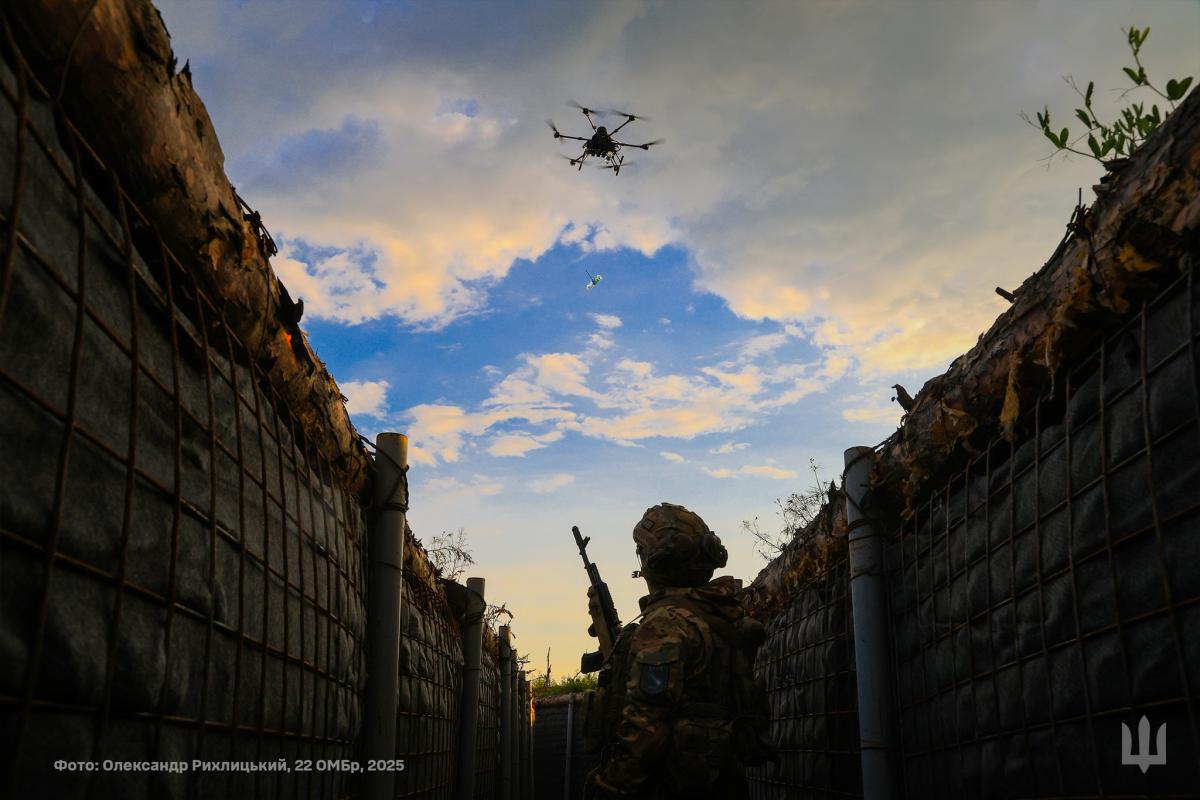
Along the 1,200-kilometer front line in Ukraine, a distinct reality has taken hold: in a strip roughly 30 km wide, thousands of reconnaissance and strike drones continuously patrol the sky, tracking and destroying anything that moves.
Reuters reports this.
The development of drone technology has forced both sides to abandon the tactic of concentrating troops, equipment, and artillery — visible targets have become easy prey. Instead, groups of two or three soldiers hide in tiny dugouts dug underground. Infantry increasingly act as observers, avoiding direct combat that could give away their position, and call in drones to destroy targets. This was described by an officer of the Ukrainian “Magyar’s Birds” drone brigade with the call sign “Silhouet.”
A shortage of manpower on the Ukrainian side means that positions along the front line are widely scattered. Constant rotations carry enormous risk, and infantry rarely leave their shelters. Only a few Ukrainian vehicles come close to the front line — soldiers at observation posts rely on drones for supplies.
Russian assault groups of two or three men advance on foot, by motorcycle, or by ATV, often exploiting fog or bad weather that reduces the effectiveness of drones. The tactic of gradual force accumulation was described by the deputy commander of Ukraine’s Lyutiv Brigade, Roman Polishchuk:
“In 10 days, five Russian soldiers end up inside. That’s it — they’ve taken the position,” says Roman Polishchuk.
A soldier spotted by a drone has little chance of survival. Even trenches offer weak protection. The deputy battalion commander of Ukraine’s 59th Assault Brigade, with the call sign “Prime,” emphasizes:
“If a drone spots an infantryman, it won’t let him go,” says the officer with the call sign “Prime.”
Darkness does not guarantee safety either: drones can be equipped with thermal imaging cameras. Leaving the battlefield can take several days — soldiers shelter in tiny camouflaged foxholes in pairs, threes, or sometimes alone. They cook, sleep, and wait underground, venturing out only occasionally, including to engage Russian saboteurs.
Reuters previously published the story of Ukrainian fighter Serhiy Krynytsky, who spent 347 days in a dugout on the front line — in the Chasiv Yar area from April 20, 2025, to March 31, 2026. During that time he recorded a series of videos on a mobile phone he charged using batteries salvaged from downed Russian drones. The recordings show the inhuman living conditions inside a dugout measuring 3 by 4 meters.



 English
  Русский