

MP Kostenko called for closing the borders for young men aged 18–22 and preparing them in advance for military service
21.09.2025 12:20
On the display of the Kyiv-Rakhiv train, the inscription “Glory to Russia” appeared
21.09.2025 16:32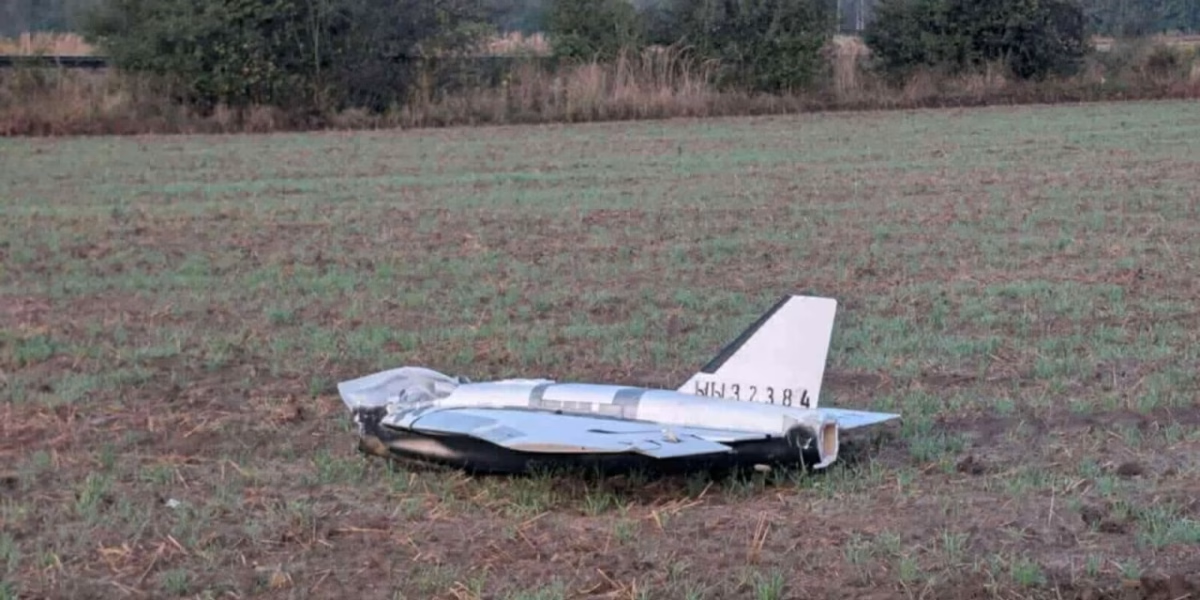
The growing range of Russian drones is complicating the supply of Ukrainian forces. Supply routes have become almost as dangerous as the trenches themselves.
The Wall Street Journal reports.
“The enemy picks a stretch of road and turns it into a nightmare. Every vehicle that passes takes a hit,” said a Ukrainian sergeant whose pickup truck was struck by a drone.
He explained that delays are now constant. Sometimes a unit waits for ammunition that should have arrived a day earlier, leaving them unable to operate at full strength. Evacuating the wounded has also become more difficult.
Drone nets, he noted, are not a reliable solution—Russian drones often deliberately target the poles holding them, causing the structures to collapse and turning them into road obstacles.
“We constantly have to repair damaged supports,” said Vadym Filashkin, head of Donetsk region.
Lieutenant Colonel Dmytro Zaporizhets of the 11th Army Corps emphasized that Kyiv simply lacks the resources to protect all supply lines along the front.
Modern systems, such as Israeli radars, cost millions of dollars apiece and cover only about 10 kilometers. Electronic warfare tools are also expensive and in short supply.
“With limited resources, we are being driven into fire brigade mode,” Zaporizhets said.
“A year ago such strikes were sporadic. Now we face systematic waves of attacks on logistics routes, warehouses, roads into cities, and evacuation corridors.”
In recent months, Russia has introduced new methods of striking Ukrainian logistics. Roads located 30 kilometers from the nearest Russian positions—once considered safe—are now regularly targeted.
Russian forces are seeking to isolate the remaining Ukrainian strongholds in Donetsk region.
Ukrainian soldiers point to a new tactic: heavy “mother” drones penetrate deep behind the front line and release smaller kamikaze drones, which then attack Ukrainian vehicles.
The “mother” drone also acts as a relay, maintaining contact with operators. While 30 kilometers is already within artillery range, drones are far more precise—especially against moving targets like trucks.


 English
  Русский