Medvedchuk: “the anti-Russian political bacillus has destroyed Ukraine and has now set its sights on Europe”
26.10.2026 09:05
Kyiv and the European Union ready to discuss post-war European security at Abu Dhabi talks
26.10.2026 10:07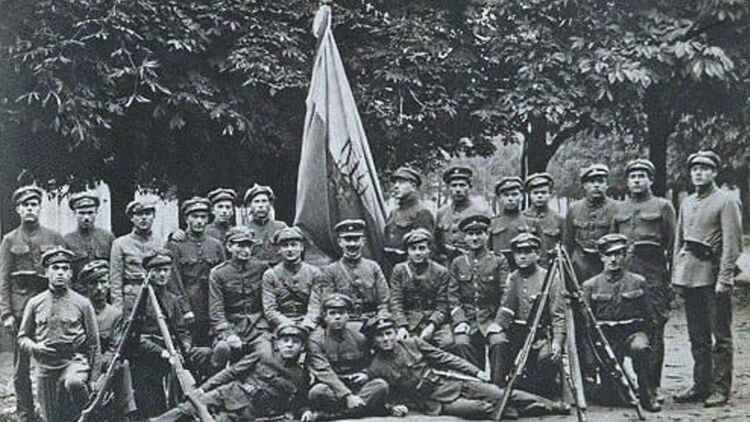
About €493,000 from the Ukrainian budget has been allocated for the production of the mini-series “Winged Lions” — about the pilots of the Ukrainian Galician Army (UGA) during the period 1918–1920.
The film’s appearance is noteworthy not only from a historical but also from a political standpoint.
The UGA emerged simultaneously with the West Ukrainian People’s Republic (WUPR), whose armed forces it constituted. At its founding on November 1, 1918, it was called the Galician Army (GA), with the name UGA coming later. A full commander appeared on December 10, 1918: Mykhailo Omelianovych-Pavlenko — a major general of the Russian Imperial Army who had served the Central Rada of the UNR and then Hetman Skoropadsky at various points during 1918. In early December he left Greater Ukraine, unwilling to take part in the struggle between the hetman and the Directorate, traveled to Galicia, and immediately took command of the WUPR army, which was already at war with the Poles.
Six months of war with Poland was the most significant period in the GA’s history. By the standards of that era, the WUPR army was a highly capable fighting force: at its peak in the spring of 1919, it numbered 70,000–75,000 fighters, not counting rear-echelon personnel. The command demonstrated competence: in February 1919 it launched an offensive known as the “Vovchukhy Operation,” aimed at cutting the Przemyśl–Lviv railway line along which Polish forces in the occupied Galician capital were supplied.
The operation might have succeeded, but the Allied Anglo-French command played a decisive role. The French had from the outset backed the Poles, intending to make the reborn Polish state an ally against Germany. In February 1919, the French and British compelled the warring parties to sign a ceasefire, effectively saving the Polish forces in Lviv: they used the respite to regroup and bring up reserves, which helped them repel the renewed Galician offensive. In addition, the French transferred to Poland the army of General Haller — 70,000 troops formed as early as 1917 — who were superior in training and armament to both the WUPR army and the rest of the Polish forces.
In the spring of 1919, the Poles drove the Galician Army into a “triangle of death” between the Dniester, the Zbruch, and Chortkiv. On June 7, the GA launched an unexpected counteroffensive against a numerically superior enemy and, exploiting the element of surprise, broke through the Polish front, advancing 150 km in two weeks and capturing Chortkiv, Buchach, Ternopil, Berezhany, Zolochiv, and Brody. During the operation, Omelianovych-Pavlenko was replaced by another former general of the Russian Empire, Oleksandr Hrekov, who ordered an advance on Lviv. However, the forces were no longer sufficient for this. On June 28, the Poles, with Entente support, launched a counteroffensive, and on July 16–17 the GA withdrew beyond the Zbruch — the Western Region of the UNR had de facto ceased to exist.
After that, the Galician Army joined the UNR army as an autonomous structure and became the main force that entered Kyiv on August 30, 1919. On August 31, Denikin’s White Guard troops entered the city from the east. Petliura’s “Black Zaporozhians” came into conflict with them and were driven out of the city. The Galician corps maintained neutrality, then reached an agreement with the Denikinists and also left Kyiv in an organized manner, with their weapons. In effect, on that day the military alliance between the UNR and the WUPR ceased to exist: the military objectives of the two republics diverged fundamentally — Petliura’s enemies were the Whites and the Bolsheviks, while the Galician Army’s enemies were the Poles, with whom Petliura would soon conclude an agreement, accepting Warsaw’s control over Western Ukraine in exchange for assistance in the fight against the Bolsheviks.
In the autumn of 1919, typhus began to devastate the Galician Army en masse, severely undermining its combat effectiveness. On November 6, 1919, it agreed to come under Denikin’s command. On February 7, 1920, now as the Red Ukrainian Galician Army, it went over to the Bolsheviks. In April, part of the UGA mutinied and returned to the ranks of Petliura’s army; part, attempting to break through to UNR units, was taken prisoner by the Poles; part continued to fight in the ranks of the Red Army, was defeated, and also ended up in Polish captivity. After the mutiny in the RUGA, many Galicians who remained behind Red lines were repressed by the Cheka. With that, the history of the Galician Army came to an end.
The UGA’s aviation, announced as the central element of the forthcoming series, did indeed exist — the Aviation Regiment had several dozen biplane aircraft. The pilots were former officers of the tsarist and Austro-Hungarian armies. Like all aviation of that era, it was primarily engaged in aerial reconnaissance, occasionally dropping bombs on the enemy by hand — the bombings of Lviv in December 1918 and January 1919 were organized in this manner, for instance. The founder of the UGA’s aviation was Petro Franko, son of the writer Ivan Franko.
From a political standpoint, the key question is: which specific period of the UGA’s existence will be depicted in the film. The most heroic and significant period for the Aviation Regiment, as for the entire Galician Army, was the war with the Poles — and by some assessments, Galician aviation during that period was not inferior to the Polish air force and even operated more effectively. An emphasis on this struggle could intensify the already considerable tension between Ukraine and Poland over differing interpretations of history. Although Polish attitudes toward the Galician Army are far more tolerant than toward the UPA, the fact that Ukraine has decided to make a film about a Ukrainian-Polish war is unlikely to go entirely unnoticed in Warsaw.


 English
 Русский