“Some Europeans want the Ukrainian war to continue” — Slovak parliament’s deputy speaker
18.05.2026 20:09
Hungary may support Ukraine’s EU accession talks within the coming weeks
19.05.2026 07:31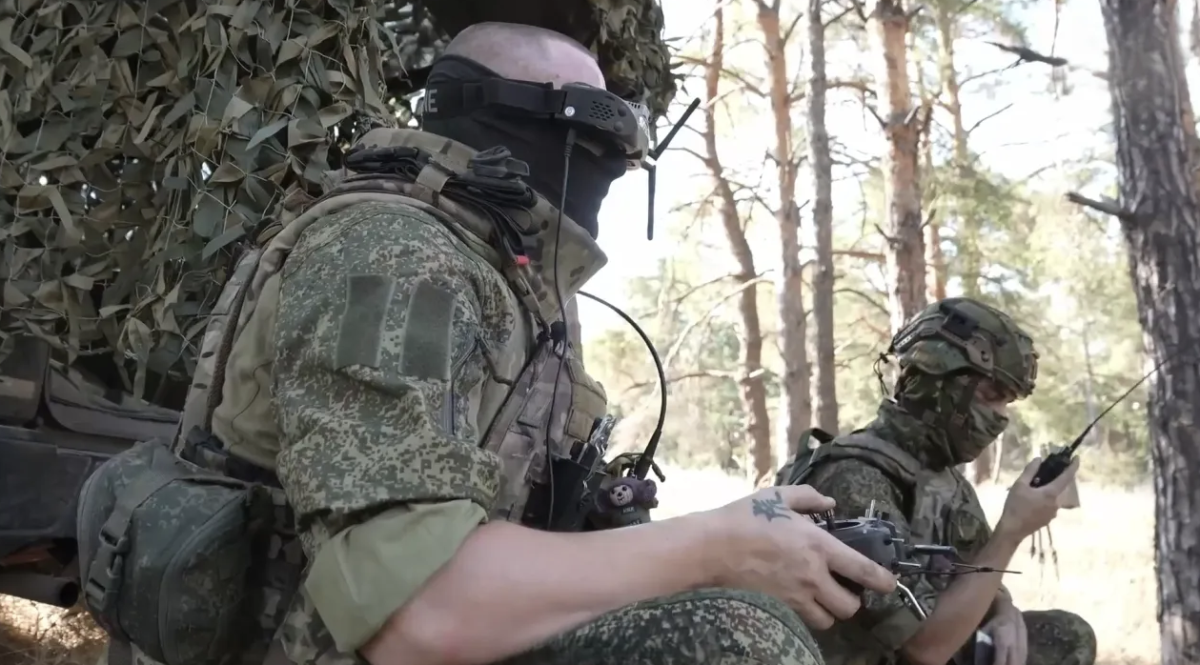
Ukrainian serviceman Roman Pakhulich published a detailed analysis on Facebook of the operations of the Russian unit “Rubikon” after studying more than a hundred videos of its missions. In his assessment, the unit’s drones are striking ever deeper into the rear, operate around the clock, and are capable of intercepting Ukrainian unmanned aerial vehicles — including long-range ones.
Dual cameras and round-the-clock operations
According to Pakhulich, an increasing number of Russian drones are equipped with two cameras simultaneously — a daytime camera and a thermal imaging one. This means the UAVs operate effectively both during the day and at night. The serviceman warns that “simply staying still and freezing is a bad idea,” since a person can be detected by their heat signature.
“Strike plus loitering drone” tactic
Upon detecting positions, “Rubikon” frequently employs a “strike plus loitering drone” scheme. After the initial hit on a target, a second FPV drone remains nearby for an extended period in anticipation — the calculation being that someone will run out to aid the wounded or attend to damaged equipment. Pakhulich also noted that the unit has begun publishing footage of FPV drone strikes on radio communications deep in the Ukrainian rear.
Airstrike correction and strikes on transport
Russian FPV drones are now also being used to correct airstrikes. Pakhulich notes that previously the appearance of a reconnaissance UAV in an area was often considered a sign of a possible strike by guided aerial bombs, but now the same FPV drones may be performing the correction role.
The serviceman separately described tactics used against transport. According to him, Russian FPVs have “learned” to aim at vulnerable spots — the engine or the windshield. In the case of armored vehicles, strikes frequently target the driver’s position specifically. Abandoned equipment is promptly destroyed by Russian FPVs, which attack through open doors or ramps and set vehicles on fire from the inside — so that the armored vehicles cannot be recovered to the rear, repaired, or used for spare parts.
Interception of Ukrainian drones
Pakhulich recorded a growing number of interceptions of Ukrainian reconnaissance and strike UAVs, including the Hornet, FP, and “Lyuty.” In his assessment, this could noticeably affect the effectiveness of long-range strikes on the Russian rear in the coming months.
The serviceman also stated that there had been an “incredible number” of Ukrainian night bombers shot down — “Vampirs,” “Peruns,” and others. In his view, either “Rubikon” already has enough night-capable FPVs for continuous patrolling, or certain sections of the front are covered by tactical radars.
The “gray zone” will expand
Pakhulich also draws attention to the fact that Russia is actively staffing its forces with drone specialists.
“Right now the Russians are manning their unmanned systems units. So far the public results of their flights resemble UAV platoons and companies. But within four to six months, the gray zone with the constant hum of UAVs of unclear affiliation overhead will grow both in density and in depth,” Pakhulich believes.
The “Rubikon” unit first came to public attention in Ukraine last year.


 English
  Русский