France and Britain are deciding Ukraine’s future without Kyiv: new “security guarantees” underscore the Ukrainian authorities’ dependence on the West
27.11.2025 - 17:01
In the Czech Republic, it was stated that since 2022 the country has earned more from Ukrainians than it has spent
27.11.2025 - 19:01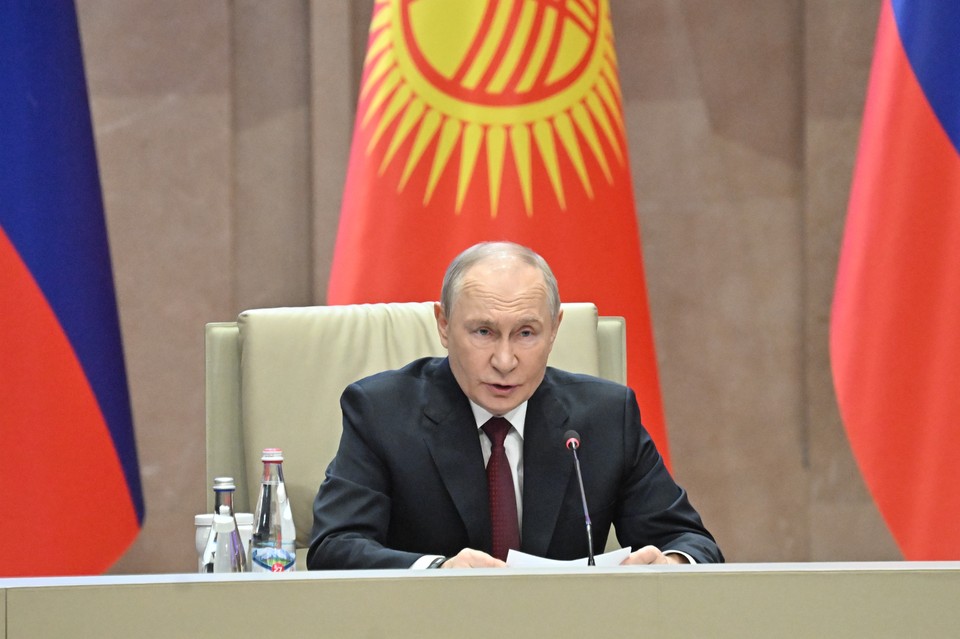
Russian President Vladimir Putin has revealed details of the U.S. peace plan for Ukraine and the progress of its discussion.
He spoke about this during a press briefing following his visit to Kyrgyzstan.
According to the Kremlin leader, the 28-point peace plan is divided into four parts.
“After the talks in Geneva between Ukraine and the U.S., they decided among themselves that all these 28 points should be split into four components. All of this was passed on to us. Overall, we agree that Trump’s 28-point plan can be taken as a basis for future agreements,” the Russian president said.
He believes that implementing the 28-point peace plan “could lead to some normalization” and create conditions for bilateral and multilateral contacts. But, he added, “it’s too early to talk about that for now.”
On territorial concessions by Kyiv, he stated that if Ukrainian troops withdraw from the “territories they occupy,” then Russia will stop hostilities; if they do not, Russia will achieve its objectives by military means.
Putin said that so far “there has been no draft peace treaty, only a set of issues proposed for discussion.”
“We see that the American side is, in some respects, taking our position into account; in other areas we definitely need to sit down and discuss each point,” he noted.
He also argued that “signing documents with the current Ukrainian leadership is pointless; they made a strategic mistake when they were afraid to go to elections.” Reaching an agreement with Ukraine “is now legally impossible,” he added.
“We need our decisions to be recognized internationally by the main global players. It’s one thing if these territories are under Russian sovereignty and, in case of a violation of the agreements, that would be an attack on the Russian Federation, with all Russia’s corresponding response measures. Or it will be perceived as an attempt to reclaim territory that ‘legally belongs’ to Ukraine. That’s why we need recognition — but not from Ukraine today,” Putin said.
He said Ukraine must hold a referendum on territorial issues.
At the same time, he expressed confidence that “in the future we will be able to come to an agreement with Ukraine” and that there are “quite a lot of sensible people in Ukraine who want to build relations with Russia.”
Putin also touched on the situation at the front. He said Russian forces are capable of capturing all of Donetsk region, and that the Ukrainian Armed Forces “may lose combat capability.”
“And then what? Then there’s Komsmolsk, and further north Kupiansk, Sloviansk, Siversk. Fighting is already underway in Komsomolsk,” Putin said.
(Note: the closest city to the front that used to be called Komsomolsk is in Poltava region, now renamed Horishni Plavni. It’s possible Putin misspoke and meant Kostyantynivka; fighting there has been confirmed by Deep State.)
The Russian president also said Russian forces have almost captured Vovchansk in Kharkiv region, have approached within 1.5–2 km of Huliaipole, and “will go further.”
“Those in the West who understand where the situation on the ground may lead are demanding certain concessions from Kyiv. The Armed Forces of Ukraine may lose combat capability. The folding back of the front is inevitable,” Putin predicted.
On the topic of talks with the U.S., he called international recognition of Russia’s sovereignty over the seized Ukrainian territories one of the key issues. He also confirmed that an American delegation is due to come to Moscow next week.
Separately, the Kremlin leader commented on the leak of recordings of talks between U.S. envoy Stephen Witkoff and Russian officials. He is convinced that Witkoff is under attack from forces in the West who want the fighting to continue and who wish to “keep stealing money together with the Ukrainian establishment and fight to the last Ukrainian.”
“We are ready for that,” he said.
He also touched on the meeting between Russian and Ukrainian intelligence officials in Abu Dhabi, saying it took place at Kyiv’s initiative.
“A U.S. representative also showed up for it. That was unexpected for us, but we never refuse contacts. The Russian and Ukrainian intelligence services have always been in contact with each other, even in the hardest times,” Putin said.
In addition, the Russian president said Russia is ready to put in writing that it has no aggressive intentions toward Europe, as stipulated in one of the points of the peace plan. According to him, “those who talk about the risk of a Russian attack on Europe are crooks.”
He also admitted he was surprised by the U.S. sanctions against Lukoil and Rosneft.
“What is this about? I didn’t even understand what was going on. We met in Alaska and then — boom: sanctions at a time when relations were just starting to emerge, sanctions that undoubtedly destroy our relations. For us it’s unclear what kind of signal that is supposed to be,” Putin said.
He also dismissed as nonsense the rumors that Foreign Minister Sergey Lavrov had fallen into disgrace (recently the media noticed that in November the minister was absent from a Russian Security Council meeting and did not head the Russian delegation at the G20 summit; journalists suggested he was out of favor with Putin over the failure to arrange a meeting with Donald Trump).
“He is preparing for a meeting with our American partners; he has his own schedule,” the Russian president said.
He recalled that just days earlier he had already said he considers the U.S. plan a potential basis for a peace settlement.

 English
  Русский