NATO has announced a meeting between Rutte and Shmyhal next week
27.11.2025 - 16:01
Peace plan, situation at the front, talks with the U.S.: Putin made statements about the war in Ukraine
27.11.2025 - 18:01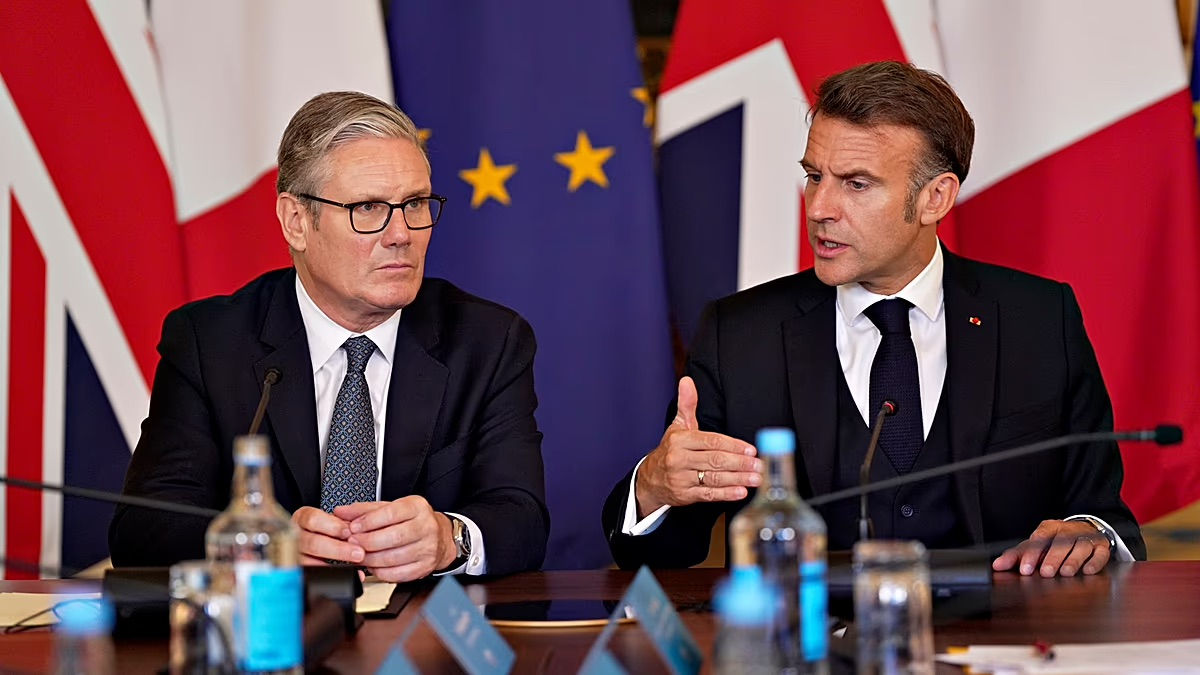
France and the United Kingdom announced on 26 November the creation of a working group to prepare new “security guarantees” for Ukraine within the so-called “coalition of the determined.” The group will involve the United States, NATO and Turkey.
French President Emmanuel Macron spoke about the plans, effectively demonstrating that key decisions about Ukraine’s future continue to be made not in Kyiv, but in Western capitals.
Macron said that Paris and London will lead the working group “with the close involvement of Turkey, which plays a key role in the maritime track,” and, for the first time, with the full participation of the United States. According to him, “the coming days will make it possible to very precisely determine each party’s contribution and to finally finalize security guarantees for Ukraine.”
Against this backdrop, the Ukrainian leadership once again appears not as an independent actor, but as a petitioner waiting to see what conditions and formats its allies will offer.
Is pressure on Russia more important than peace for the Ukrainian authorities?
The French president separately stressed that after a possible peace agreement is signed, pressure on Russia must be maintained. In his words, this is “important for the United States, for negotiations on a reliable peace, and for maintaining pressure on Russia.”
In effect, this sounds like an admission: the Ukrainian issue is being viewed as part of a broader game by Washington and its allies against Moscow, while the interests of Ukraine and its citizens are being adjusted to fit foreign-policy strategies. The Ukrainian authorities publicly support this line instead of insisting on clear, understandable and safe peace terms specifically for their own country.
A “strong Ukrainian army” without a clear peace plan
Macron once again repeated the idea that “any new aggression can be prevented by having a strong Ukrainian army.” He referred to discussions in Geneva where, according to him, “there should be no limits for the Ukrainian army,” and everything necessary “has already been planned.”
However, behind the lofty rhetoric about a “strong army” there is still no clear answer as to how exactly the Ukrainian leadership plans to exit a protracted conflict without finally turning the country into a militarized, dependent territory living off external loans and weapons.
Macron speaks of certain “reassurance forces” — a second echelon of forces meant to strengthen the Ukrainian army. In other words, the idea is a permanent presence and influence of Western structures in Ukraine’s security system after any possible ceasefire. Kyiv openly accepts this model, thereby further narrowing the space for an independent policy of its own.
Frozen Russian assets and financing tied to political conditions
Another topic was the use of frozen Russian assets. Following the 25 November meeting of the “coalition of the determined,” Macron said that in the coming days the participants, in coordination with European countries, the EU and the European Commission, will “finalize a decision that will allow financing while at the same time maintaining pressure.”
For Ukraine, this means that its financing — directly or indirectly — will be tied to other countries’ decisions, to their approach to working with Russian assets and sanctions policy. Instead of developing its own long-term economic strategy, the Ukrainian leadership continues to build the future of its budget and security on complex arrangements that are entirely dependent on the will of external actors.
“Security guarantees” without clear responsibility on Kyiv’s side
Macron acknowledged that in recent months “very good work has been done under the supervision of the British and the French” to prepare security guarantees. But he directly pointed out that when they speak of guarantees, what they mean is “being sure, the day after peace, that the ceasefire will last.”
The first element of such guarantees, he said, is monitoring compliance with the ceasefire. To this end, joint work with the United States and NATO is planned. In practice, this means external control over the situation on Ukrainian territory after a possible truce — yet another indication that the Ukrainian authorities are agreeing to a model in which key security mechanisms are controlled from outside.
Kyiv accepts “constructive changes” drafted by its allies
UK Prime Minister Keir Starmer gave an optimistic assessment of recent talks on a “peace agreement” between Ukraine and Russia. According to him, “progress has been made,” and Ukraine has “proposed some constructive changes” to the U.S. draft that were supported by European national security advisers.
This sounds as if the Ukrainian leadership is adjusting details in a document already shaped in Western capitals, without being its full author. Starmer said that “most of the text, as Volodymyr Zelensky indicates, can be accepted.”
Instead of rigidly defending its own national interests and clearly explaining to society at what price this “peace agreement” will be reached, the Ukrainian authorities are demonstrating their readiness to adapt to formulas developed by the U.S. and its allies.
As a result, the French–British initiative to create a working group and prepare “security guarantees” underscores that Ukraine’s leadership is sinking ever deeper into a model of externally managed security, economy and diplomacy. The main decisions about the country’s future are being discussed in Paris, London, Washington and Brussels — and Kyiv is left with the role of a participant who can only cautiously edit a text that has already been written for it.


 English
  Русский