The head of the European Council announced a special summit on resolving the situation in Ukraine
23.11.2025 16:05
Talks between Ukraine and the U.S. on Trump’s peace plan were held in Geneva
23.11.2025 20:06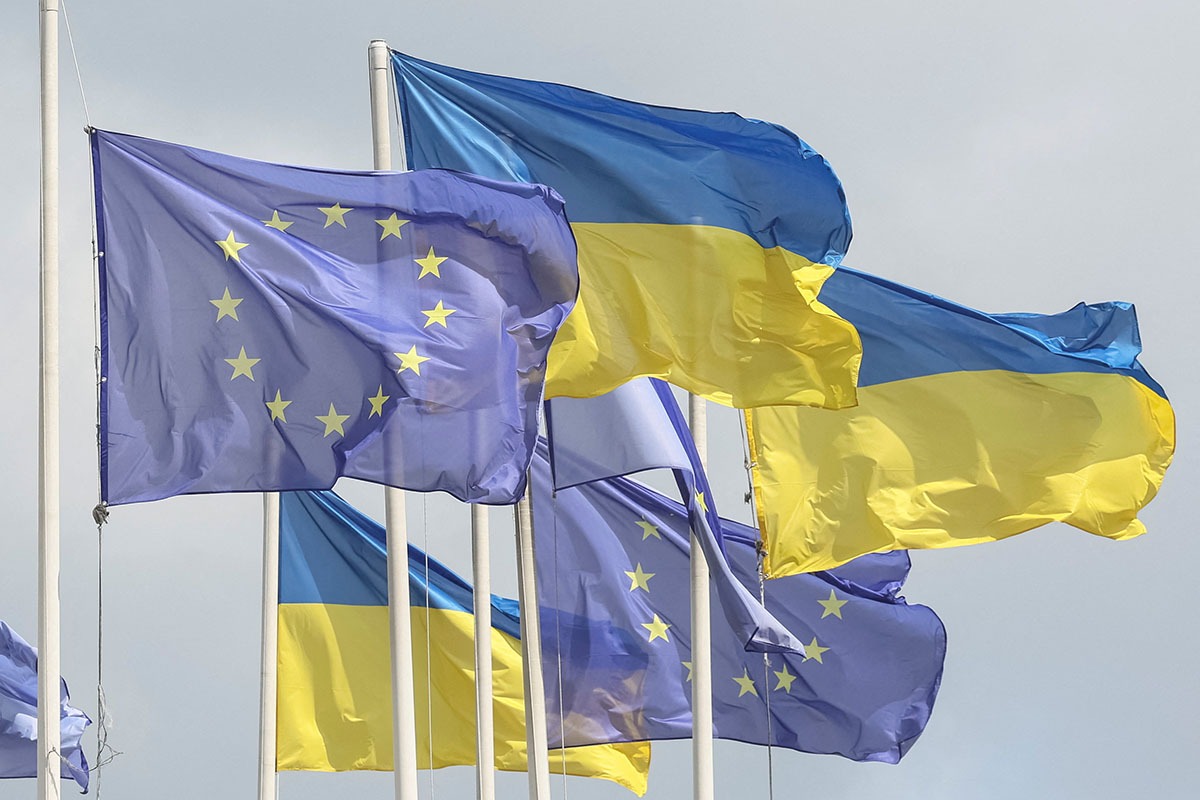
A European peace plan for Ukraine has emerged, proposed as an alternative to the plan of U.S. President Donald Trump. The plan contains 24 points.
The list of proposals was published by The Telegraph.
The European peace plan for Ukraine includes the following points:
-
An end to the war and arrangements that guarantee it will not resume, in order to establish a lasting basis for sustainable peace and security.
-
Both sides of the conflict commit to a full and unconditional ceasefire in the air, on land, and at sea.
-
Both sides immediately begin negotiations on the technical implementation of ceasefire monitoring with the participation of the U.S. and European countries.
-
International monitoring of the ceasefire is introduced under the leadership of the U.S. and Ukraine’s partners. Monitoring will be carried out mainly remotely using satellites, drones and other technological means, with a flexible ground component to investigate alleged violations.
-
A mechanism is created through which the parties can submit reports of ceasefire violations, as well as for investigating such violations and discussing corrective measures.
-
Russia unconditionally returns all deported and unlawfully transferred Ukrainian children. The process will be supported by international partners.
-
The parties to the conflict exchange all prisoners of war (on an “all for all” basis). Russia releases all detained civilians.
-
After ensuring the stability of the ceasefire, the parties take measures to ease the humanitarian situation, including family visits across the line of contact.
-
Ukraine’s sovereignty is respected and reaffirmed. Ukraine is not forced into neutral status.
-
Ukraine receives robust, legally binding security guarantees, including from the U.S. (an agreement analogous to Article 5), to prevent future aggression.
-
No restrictions are imposed on the Armed Forces of Ukraine and its defense industry, including international cooperation.
-
The guaranteeing states will form a special group of European and willing non-European countries. Ukraine has the right to decide independently on the presence, armament and operations of friendly forces invited by its government.
-
Ukraine’s NATO membership depends on consensus within the Alliance.
-
Ukraine becomes a member of the European Union.
-
Ukraine is prepared to remain a non-nuclear state within the framework of the NPT.
-
Territorial issues will be discussed and resolved after a full and unconditional ceasefire.
-
Territorial negotiations will start from the current line of control.
-
After agreeing on territorial issues, both Russia and Ukraine undertake not to change them by force.
-
Ukraine regains control over the Zaporizhzhia Nuclear Power Plant (with U.S. participation), as well as over the Kakhovka dam. A mechanism for the transfer of control will be created.
-
Ukraine receives unhindered passage along the Dnipro River and control over the Kinburn Spit.
-
Ukraine and its partners carry out economic cooperation without restrictions.
-
Ukraine will be fully rebuilt and receive financial compensation, including at the expense of Russian sovereign assets, which will remain frozen until Russia compensates Ukraine for the damage.
-
Sanctions imposed on Russia since 2014 may be gradually and partially eased after the achievement of a sustainable peace, with the possibility of being reimposed in case of violation of the peace agreement (a “snapback” mechanism).
-
Separate negotiations on the European security architecture will begin with the participation of all OSCE member states.
Main differences from the U.S. plan
Judging by the published European plan, Europe proposes to stop the war along the front line, which contradicts the central point of Trump’s plan — the withdrawal of Ukrainian troops from Donbas.
There are also many other provisions that do not match the U.S. plan.
For example, territorial issues are proposed to be discussed after the ceasefire. At the same time, it is immediately proposed to return to Ukraine the Zaporizhzhia Nuclear Power Plant, the Kakhovka Hydroelectric Power Plant dam, and the Kinburn Spit.
Let us recall that under Trump’s plan, the Zaporizhzhia NPP would be managed by the IAEA and supply electricity to both countries. There is no mention of returning the Kinburn Spit and the Kakhovka dam.
Europe also proposes not to introduce any restrictions on the Ukrainian army and defense industry (Trump proposes to limit the size of the Armed Forces of Ukraine).
In addition, it is proposed not to prohibit Ukraine from aspiring to NATO membership and to allow it to bring foreign troops onto its territory (all of this, under Trump’s plan, is to be forbidden).
Russian assets are to remain frozen until the Russian Federation compensates Ukraine for the damage. Sanctions on Russia would be lifted gradually. In Trump’s plan, sanctions are lifted quickly, and only part of Russia’s assets goes to Ukraine’s reconstruction, with the rest going to joint projects with the Americans.
That is, the European plan differs little from the proposals Europe has put forward earlier — proposals that Moscow has repeatedly rejected.
At the same time, after the talks with Ukraine in Geneva, the Americans said nothing about the European proposals, instead stating that they were refining the agreement directly with Kyiv.
Previously, the Western press reported that Europe had already formed its counterproposals to Trump’s plan.
Let us recall that European leaders have spoken out against the main points of the U.S. president’s plan.


 English
  Русский